
Your company ships out large amounts of products daily with the goal to provide the best customer service you can. You want to be a leader in your industry and efficiently get products into the hands of your customers. Like many companies, you might want to continually better your operations, but where should you begin your warehouse improvement process?
The efficiency of your shipping process flow can be the key to improving success for your company. Reevaluating your shipping logistics process, the equipment and shelving in your warehouse and other aspects of your picking and packaging processes will help identify areas that you can improve.
To learn more about how to optimize the shipping process for your company, check out this helpful guide with solutions and tips for warehouse efficiency.
Jump to Sections:
- Challenges for Shipping Warehouses
- How to Optimize Your Shipping Process
- Implement Inventory Control and Order Tracking
- Warehouse Layout Considerations
- Solutions to Optimize the Shipping Process
Challenges for Shipping Warehouses
Warehousing and shipping processes can be complicated procedures. Many variables interact throughout the logistics process for a successful outcome.
Try to identify possible shipping challenges to notice if your warehouse is experiencing any or to prevent them from occurring. Here are some common warehouse issues that can hinder your shipping productivity:
- Incomplete inventory records: You can notice an inaccurate inventory record when an employee goes to retrieve a product, and it’s not at the specified location, or they go to store a pallet of products in a place that is already stocked.
- Repetitive actions: Several unnecessary pallet moves or duplicated inventory data can impact shipping efficiency.
- Poor space utilization: Warehouses that don’t optimize their layout or utilize their space to its maximum capabilities may see a decrease in their shipping efficiency.
- Inefficient product picking: Poor procedures, inadequate equipment and inaccurate inventory records can impact your picking productivity.
- Seasonal product layouts: Warehouses that don’t consider seasonal product changes when organizing inventory may see a slow down in shipping efficiency.
- Product damage: Of course, damaged products can impact warehouse shipping operations by leading to adding extra time to the picking and transporting process.
Warehouse employees can find solutions to many challenges they may encounter in their shipping process. Your company can learn how to improve the shipping process by reading through our solutions.
How to Optimize Your Shipping Process
You have many options for increasing your warehouse efficiency and productivity. Complete an audit of your current procedures to determine areas that you could improve.
You can help your employees accomplish their jobs effectively and increase their productivity by optimizing the shipping process. Take a look at these logistics solutions and see if they can help increase productivity in your warehouse.
Create a Standard Operating Procedure
All processes, especially those executed in a warehouse, should follow a detailed and comprehensible standard operating procedure. Operating procedures allow all employees to be on the same page during their shifts and make identifying problems easier.
An employee can write up a detailed checklist that outlines the shipping and logistics process of your warehouse. Point out what types of packaging employees use with certain products, safety procedures throughout the warehouse and while using material handling equipment, employee roles and shift-changing procedures.
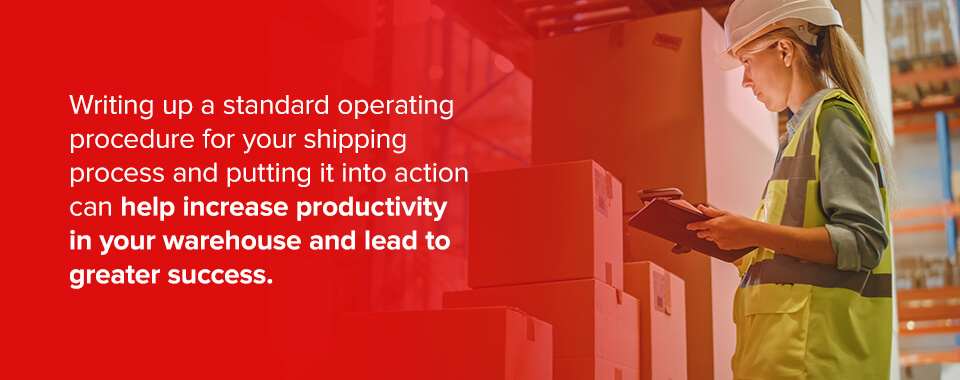
Writing up a standard operating procedure for your shipping process and putting it into action can help increase productivity in your warehouse and lead to greater success.
Organize Your Products
Your shipping warehouse has aisles and shelves stocked with large quantities of your products. One of the most crucial aspects of productivity in any industry is organization. A well-organized facility can lead to a sustainable and productive shipping process when you follow warehouse picking best practices for your shipments.
You can organize your products by applying labels and signage through the warehouse and on shelving. This is a simple and inexpensive step that you can incorporate into your warehouse right away. This will make it clear to employees picking orders that they are locating the correct products without confusion. It will also help ensure employees stock items in the right location.
Consider organizing your products by their popularity. Placing products employees commonly pick and ship on easily accessible shelving that is closest to the dock or packing location can help decrease the time spent picking products.
You can also improve space use with plastic collapsible containers. Storing items in collapsible containers rather than directly on shelving can help prevent product damage and improve your product management. Collapsible containers work well in various industries, and companies can choose from an array of container sizes that will meet their product and storage needs.

Optimize Packaging Design
Proper packaging is an essential aspect of the shipping industry. Quality packaging protects the inventory during storage and shipping.
Companies should know the importance of packing logistics and its impact on their shipping process and customer satisfaction. Reevaluating your packaging process can help identify better solutions for your packaging design choices.
Products require different packaging based on their materials and storage conditions. Food, chemicals and other sensitive products may need special treatment to ensure their safety. You might want to keep large items on pallets for easier transportation, or you might need smaller containers for portioning out bulk items.
The best packaging is reliable, durable and effective without being overly complicated for employees to pack or customers to unpack. Optimized packaging can speed up packing time and improve the efficiency of your shipping processes overall.
Implement Inventory Control and Order Tracking
Keeping accurate records of your inventory and knowing exactly what items you have in your warehouse is crucial for a successful and efficient shipping process. Having an inventory control process is beneficial to optimize your shipping procedures.
What is inventory control exactly? Inventory control describes the method your company uses to track your warehouses’ inventory, so you have an accurate count of items in stock, items that have sold and items you’ve ordered to restock. Inventory control can be as simple as a single spreadsheet or as complex as a fully integrated software program that automatically tracks inventory across multiple warehouses and sales platforms.
Using an inventory control tool can help you store, track and ship your products more efficiently. Completely organizing your warehouse and tracking your inventory can lead to a smoother shipping process and decrease downtime at your facility.
Additionally, using order tracking software can help employees package orders more efficiently. Implementing this type of tool can reduce downtime in the warehouse and allow the workflow to be more effective and productive.
Your employees and your customers will benefit from effective inventory control procedures and order tracking software.
Use Effective Equipment
Organizing your inventory and keeping accurate records is a big help in shipping optimization, but using the best equipment for the job can make picking products much easier and more efficient. Many types of material handling equipment are available for warehouses, and it’s important you select the types that will work best in your facility.
Industrial equipment, such as pallet trucks, hand trucks or dollies, is great for order picking and quickly moving orders around the warehouse. This equipment will make lifting heavy pallets much easier and safer.
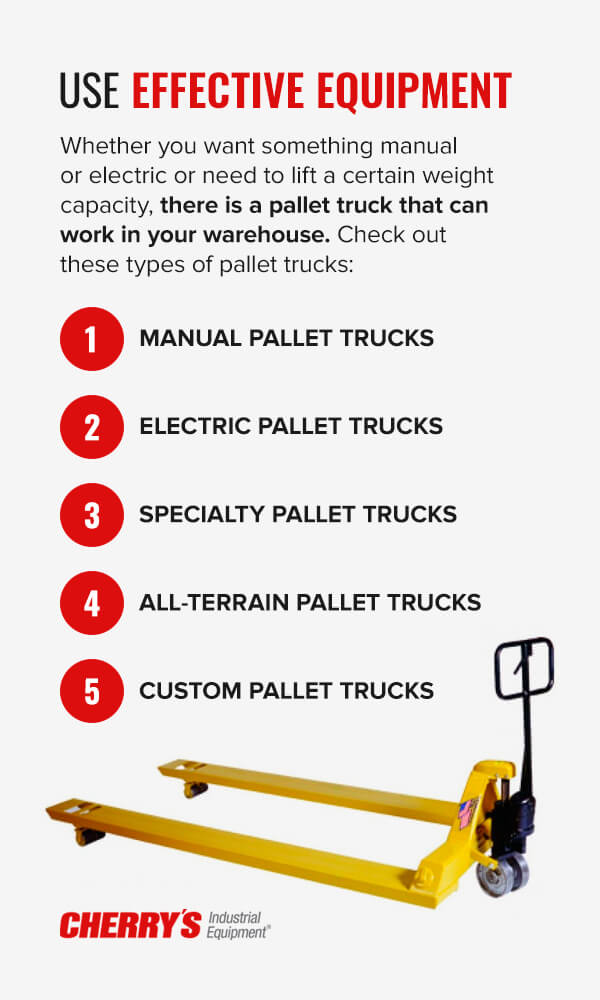
If you’re looking for a pallet truck or pallet jack for your warehouse, you can choose from various types. Whether you want something manual or electric or need to lift a certain weight capacity, there is a pallet truck that can work in your warehouse.
Check out these types of pallet trucks:
- Manual pallet trucks: A manual pallet truck is a more affordable option when it comes to purchasing a pallet truck. These units are easy to maneuver and don’t require as much maintenance as a motorized truck.
- Electric pallet trucks: Using electric pallet trucks in your warehouse offers various advantages for your warehouse team. With an electric unit, your operator has an easier time moving the equipment. These units also offer better maneuverability, and it’s easier for an employee to get their certification on a pallet jack as opposed to a forklift.
- Specialty pallet trucks: Not all loads of products are the same. Some require a certain type of pallet truck to transport them around the warehouse. Specialty pallet trucks are perfect for a pallet load that requires shorter forks, higher reach, narrow-aisle capabilities and more. Various specialty trucks can help improve your shipping process.
- All-terrain pallet trucks: If you utilize outdoor space at your facility for products like lumber, agricultural or industrial materials, an all-terrain pallet truck can be the most effective in that environment. These off-road units are built to handle the elements of an outdoor facility. You can rely on this equipment to be stable and durable as it transports your products around the worksite. All-terrain pallet trucks can also be gas- or electric-powered. These trucks have the power to handle rough terrain and will benefit companies with outdoor worksites or move products inside and outside of their warehouse.
- Custom pallet trucks: Even with the wide selection of pallet trucks, you may still need a piece of equipment that is specific to your industry or products you carry. If you have a job that requires a specific size, fork length or capacity, then a custom pallet truck may be the solution for your warehouse.
When choosing to use material handling equipment in your facility, you need to ensure the employees who will be operating the equipment receive the proper training and equipment certification. Preventing warehouse accidents and injuries should be a priority at your facility to keep your employees safe and your shipping process running smoothly.
Warehouse Layout Considerations
One factor that can save you time, money and space is your facility’s layout. Examine how your warehouse looks right now. Is everything accessible, with enough space to allow an uninterrupted flow for people and equipment? Each warehouse should create a layout that employees can organize easily and walk through safely and that allows enough space for products, materials and machines.
It’s best for the flow of your warehouse to include clear paths and organization that make sense to your shipping process. Consider where the high traffic areas in your warehouse will be and the best space for them, so there isn’t a build-up of people or equipment in one area. A goal for a great layout in your warehouse is to strive for the least amount of disruption and allow for a consistent flow of procedures.
When you’re storing products in your warehouse, you should keep the accessibility of your items in mind. Consider how these products will be transported and picked from the shelves. This will help when you start choosing where to store the products and the type of packaging they will require.
Using as much of your warehouse space as you can while still having a comfortable amount of room for aisles and pathways will help optimize your shipping process. To maximize your warehouse space, install beneficial storage systems, like pallet racking, and use quality industrial pallets to store your products.
Your warehouse is a vital part of the supply chain. Having an efficient warehouse layout with high-quality industrial storage solutions can improve productivity and safety in your company’s facility.
Solutions to Optimize the Shipping Process
This guide has provided numerous solutions for enhancing your shipping process. Shipping is reliant on all of the processes that preceded it, like ordering, picking and labeling. Warehouses successfully ship products when employees are on the same page regarding all procedures.
What other products can your use in your warehouse for smoother operations? Check out these industrial products to see if your shipping process can benefit from them:
- Wire containers
- Metal bulk containers
- Container tilters
- Table lifters
- Machine skates
- Roller skids
- Toe jacks
- Heavy transport dollies
Your warehouse optimization solution will be unique to your company and your team. It’s important to examine your situation to determine what options will improve your shipping process.

Shop Online With Cherry’s Material Handling
Shopping for material handling supplies can be straightforward and simple if you find the right company. With various equipment dealers and storage shelving providers, it’s important to find a company that has high-quality products that will make an impact on your warehouse procedures and be beneficial to your employees.
If you’re searching for a trusted supplier of industrial products in the material handling industry, check out Cherry’s Material Handling. For businesses big or small, we have products and equipment that can help improve your warehouse productivity and shipping practices.
We pride ourselves on providing excellent customer service and knowledgeable information on our products. We want to offer the best warehouse solutions for your company, and our products can improve your shipping process. Cherry’s Material Handling offers equipment, containers, safety products, pallet racking and packaging to companies in various industries. We make it easy and safe to shop on our website so you can order the products your warehouse needs online.
If you have any questions or need assistance, contact us through our online form or give us a call at 877-350-2729 to learn more.